Vendor Onboarding:
Process, Checklist & Best Practices
What Is Vendor Onboarding?
Vendor onboarding is the process of evaluating, approving, and integrating third-party vendors before they gain access to systems, sensitive data, or critical business operations. In a modern third-party risk management (TPRM) program, the vendor onboarding process helps organizations apply risk-based due diligence, gather required documentation, and establish a clear path to ongoing oversight.
Historically, vendor onboarding was often treated as a procurement-driven activity focused on contracts, payment setup, and supplier activation. Today, organizations rely on vendors for cloud infrastructure, software, managed services, customer support, payment processing, and other critical business functions, making onboarding a key control point for cybersecurity, compliance, operational resilience, and business continuity.
Because vendor relationships can introduce security, regulatory, financial, and operational risk, organizations need a structured vendor onboarding workflow that scales based on vendor criticality, data access, and business impact.
As part of a broader third-party risk management strategy, vendor onboarding connects directly to related activities such as vendor due diligence, inherent risk assessments, contract controls, and continuous monitoring.
As a result, vendor onboarding has become one of the most important control points within a modern third-party risk management (TPRM) program.
A mature vendor onboarding process helps organizations:
- Identify potential risks before engagement
- Apply risk-based due diligence requirements
- Improve consistency across business units
- Accelerate vendor approvals
- Establish governance controls
- Support regulatory compliance
- Create the foundation for ongoing vendor oversight
Why Vendor Onboarding Matters
Every new vendor introduces potential risk.
Whether a vendor processes customer data, hosts critical applications, supports financial operations, or provides essential business services, organizations are ultimately accountable for understanding and managing the risks those relationships create.
At the same time, business stakeholders expect vendors to be onboarded quickly so projects can move forward, products can launch, and operational initiatives can stay on schedule.
This creates a challenge for risk teams:
How do you onboard vendors efficiently without sacrificing oversight and governance?
Organizations that rely on manual onboarding processes often struggle with assessment backlogs, delayed approvals, inconsistent evaluations, and limited visibility into onboarding progress.
As vendor ecosystems continue to expand, these challenges become increasingly difficult to manage.
The State of Vendor Onboarding Today
64%
of large organizations take more than 4 months to complete a third-party assessment.
60%
of organizations wait more than 4 months for vendor questionnaire responses.
16%
of organizations complete 90–100% of remediation activities before onboarding a vendor.
Source: ProcessUnity State of Third-Party Risk Assessments 2026, Ponemon Institute (1,465 respondents).
These findings highlight the growing disconnect between business expectations for speed and the operational realities of third-party risk management.
Leading organizations address this challenge through risk-based onboarding programs that align review requirements with vendor criticality, data access, and operational impact.
Vendor Onboarding Process at a Glance
| Step | Objective | Key Activities |
|---|---|---|
| Vendor Intake | Understand business need | Collect vendor and service information |
| Inherent Risk Assessment | Determine risk level | Evaluate criticality, data access, and business impact |
| Vendor Due Diligence | Validate controls | Review questionnaires, documentation, and evidence |
| Vendor Risk Assessment | Assess exposure | Identify risks, gaps, and remediation needs |
| Approvals & Contract Controls | Authorize engagement | Complete reviews and governance approvals |
| Ongoing Monitoring Preparation | Maintain oversight | Establish monitoring and reassessment requirements |
Organizations with mature TPRM programs calibrate each step according to vendor risk so low-risk vendors move through streamlined workflows while high-risk vendors receive enhanced scrutiny.
The 6 Steps of the Vendor Onboarding Process

Vendor Intake
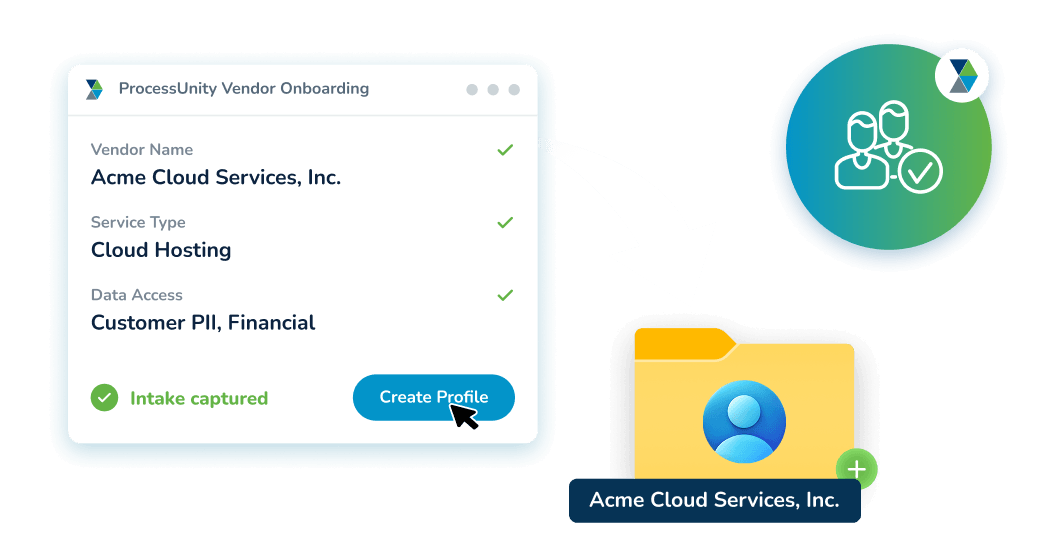
The onboarding process begins when a business stakeholder requests a new vendor relationship.
During intake, organizations collect foundational information including the vendor’s services, intended business use case, system access requirements, data handling responsibilities, geographic footprint, and operational dependencies.
This step establishes the context needed to understand how the vendor will support the organization and what level of review may be required.
Effective intake processes eliminate ambiguity early and help ensure downstream assessments are appropriately scoped.

Inherent Risk Assessment & Vendor Tiering
Before evaluating a vendor’s controls, organizations must first determine the level of risk the vendor could introduce.
Inherent risk assessments commonly evaluate:
- Data sensitivity
- System access
- Regulatory exposure
- Financial impact
- Customer impact
- Operational criticality
- Dependency risk
Based on these factors, vendors are assigned a risk tier.
Risk tiering enables organizations to focus resources where they matter most. Low-risk vendors may receive streamlined reviews, while critical vendors undergo enhanced due diligence and governance oversight.

Vendor Due Diligence
Vendor due diligence focuses on evaluating whether a vendor can effectively manage risk.
This phase often includes:
- Security reviews
- Privacy assessments
- Financial reviews
- Compliance validation
- Business continuity evaluations
- Fourth-party assessments
Organizations gather information through questionnaires, documentation requests, interviews, and external intelligence sources.
The objective is to understand whether the vendor’s controls align with organizational requirements and risk tolerance.

Vendor Risk Assessment & Evidence Review
Evidence review is often the most time-consuming component of onboarding.
Organizations commonly review:
- SOC 2 reports
- ISO 27001 certifications
- Penetration testing summaries
- Security policies
- Incident response plans
- Business continuity documentation
- Regulatory attestations
The goal is to validate vendor claims and identify potential control gaps.
Assessment Bottlenecks Continue to Slow Onboarding
64%
of large organizations take more than 4 months to complete a third-party assessment.
60%
of organizations wait more than 4 months for vendor questionnaire responses.
Source: ProcessUnity State of Third-Party Risk Assessments 2026, Ponemon Institute (1,465 respondents).
These findings explain why many organizations are investing in workflow automation, assessment standardization, shared assessment data, and AI-assisted evidence reviews.

Approvals & Contract Controls
Following assessment activities, stakeholders review findings and determine whether the vendor can be approved.
Approvals commonly involve:
- Procurement
- Information Security
- Legal
- Privacy
- Compliance
- Business Owners
Organizations also establish contractual protections such as breach notification requirements, audit rights, service-level agreements, data protection obligations, and subcontractor requirements.

Ongoing Monitoring Preparation
Vendor onboarding should not end when a contract is signed.
Organizations should establish:
- Monitoring requirements
- Reassessment schedules
- Escalation procedures
- Risk ownership
- Reporting expectations
This ensures onboarding becomes the foundation for ongoing vendor oversight rather than a standalone compliance activity.
Vendor Onboarding Checklist
A vendor onboarding checklist helps teams standardize reviews, reduce delays, and ensure required steps are completed before a third party is approved. While the exact checklist should vary by vendor risk tier, most organizations should confirm the following:
- Confirm the business need and vendor scope
- Collect vendor profile, service, and ownership information
- Complete an inherent risk assessment and vendor tiering
- Request due diligence questionnaires and supporting documents
- Review security, privacy, compliance, financial, and resilience controls
- Document findings, remediation items, and exceptions
- Obtain internal approvals and finalize contract controls
- Set monitoring, reassessment, and reporting requirements
Using a consistent checklist improves governance and helps organizations move low-risk vendors through streamlined workflows while applying enhanced scrutiny to high-risk or critical third parties.
Not every vendor requires the same level of review. Leading organizations align vendor onboarding requirements with inherent risk, business criticality, data access, and regulatory exposure.
Risk-Based Vendor Onboarding Requirements Sample
| Requirement | Low Risk | Medium Risk | High Risk | Critical Vendor |
|---|---|---|---|---|
| Inherent Risk Assessment |

|
|
|
|
| Security Questionnaire | Limited | Standard | Enhanced | Enhanced |
| SOC 2 / ISO Review | Optional | Recommended | Required | Required |
| Financial Review | Optional | Optional | Required | Required |
| Legal Review | Limited | Standard | Required | Required |
| Executive Approval | No | No | Sometimes | Often |
| Continuous Monitoring | Annual | Quarterly | Ongoing | Continuous |
This approach improves efficiency while ensuring resources are focused on the vendors that pose the greatest risk.
Common Vendor Onboarding Documentation Requirements
Organizations frequently request documentation to validate a vendor’s security, compliance, privacy, and operational resilience posture.
Common requirements include:
| Document | Purpose |
|---|---|
| SOC 2 Type II Report | Validate security controls |
| ISO 27001 Certification | Confirm security program maturity |
| Incident Response Plan | Evaluate breach readiness |
| Business Continuity Plan | Assess resilience capabilities |
| Data Protection Agreement | Protect sensitive information |
| Financial Statements | Evaluate financial stability |
| Penetration Test Summary | Review security testing practices |
| Subprocessor Inventory | Understand fourth-party exposure |
The specific requirements should align with vendor risk tier, business criticality, and regulatory obligations.
Vendor Onboarding vs. Vendor Due Diligence
Vendor onboarding and vendor due diligence are often used interchangeably, but they are not the same thing.
Vendor onboarding is the broader process of evaluating, approving, contracting with, and integrating a vendor into the organization.
Vendor due diligence is one component of that larger process. It focuses specifically on evaluating a vendor’s controls, risk posture, and ability to meet organizational requirements.
Think of onboarding as the entire journey from vendor request to activation. Due diligence is the risk evaluation stage within that journey.
This distinction matters in TPRM programs because teams often need separate workflows for intake, risk assessment, contracting, and ongoing monitoring, even though those activities are closely connected.
| Vendor Onboarding | Vendor Due Diligence |
|---|---|
| End-to-end approval process | Risk evaluation activity |
| Includes intake, approvals, and activation | Focuses on controls and evidence |
| Involves multiple stakeholders | Primarily risk-focused teams |
| Ends at activation | Ends when risk findings are documented |
A typical onboarding workflow follows this sequence:


Organizations that clearly separate onboarding workflows from due diligence activities often achieve greater consistency, stronger governance, and better visibility into onboarding performance.
Common Vendor Onboarding Challenges
Despite significant investments in risk management, many organizations continue to face operational challenges during onboarding.
Assessment Backlogs
Growing vendor populations create increasing demand for assessments. Limited resources often make it difficult to keep pace.
Vendor Response Delays
Obtaining completed questionnaires and supporting documentation remains one of the most common causes of onboarding delays.
Evidence Review Bottlenecks
Manual reviews of SOC reports, certifications, policies, and security documentation consume significant time and effort.
Limited Visibility
Without centralized workflows, organizations struggle to understand onboarding status, identify bottlenecks, and manage stakeholder accountability.
Remediation Remains a Major Challenge
16%
of organizations complete 90–100% of remediation activities before onboarding a vendor.
Source: ProcessUnity State of Third-Party Risk Assessments 2026, Ponemon Institute.
This highlights the importance of remediation workflows, exception management processes, and continuous monitoring capabilities that help organizations manage residual risk after onboarding is complete.
Vendor Onboarding Best Practices
Organizations that improve vendor onboarding typically focus on repeatable, risk-based processes that balance speed with governance. Best practices include:
- Start with standardized intake forms so every request captures the information needed for risk scoping
- Use inherent risk tiering to determine the right level of due diligence and review
- Centralize documentation, approvals, and status tracking to improve visibility
- Define ownership across procurement, security, legal, compliance, and business stakeholders
- Document remediation plans and exception handling before vendor activation
- Automate repetitive tasks where possible to reduce bottlenecks and manual effort
- Treat onboarding as the beginning of ongoing monitoring, not the end of risk oversight
When these best practices are difficult to scale manually, workflow automation and centralized TPRM systems can help organizations improve speed, consistency, and accountability.
How Vendor Onboarding Software Improves Efficiency
Vendor onboarding software helps organizations improve efficiency, consistency, and visibility across the onboarding workflow.
Modern vendor onboarding platforms help automate:
- Inherent risk assessments
- Vendor questionnaires
- Evidence collection
- Evidence review workflows
- Approval routing
- Remediation tracking
- Reporting and dashboards
- Continuous monitoring
By reducing manual handoffs and standardizing workflows, automation helps organizations shorten onboarding timelines while maintaining stronger governance.
Solutions such as the ProcessUnity TPRM Platform can support this effort with configurable workflows, centralized vendor records, automated assessments, integrated third-party intelligence, and continuous monitoring capabilities.
How AI Is Transforming Vendor Onboarding
Artificial intelligence is changing how organizations perform vendor assessments and evidence reviews by helping teams analyze documentation faster, surface potential gaps, and prioritize higher-risk relationships.
AI is increasingly being adopted to reduce manual effort in questionnaires, evidence analysis, and review workflows.
According to the ProcessUnity State of Third-Party Risk Assessments Report:
44%
of organizations currently use AI within assessment processes.
37%
plan to implement AI-driven capabilities.
Source: ProcessUnity State of Third-Party Risk Assessments 2026, Ponemon Institute (1,465 respondents).
AI-assisted onboarding can help organizations:
- Accelerate questionnaire completion
- Analyze evidence documentation
- Identify control gaps
- Prioritize high-risk vendors
- Improve assessment consistency
- Reduce repetitive review activities
Capabilities such as Assessment Autofill and Evidence Evaluator can help organizations accelerate vendor reviews by analyzing documentation, validating controls, and reducing manual assessment effort.
Frequently Asked Questions
Vendor onboarding is the process of evaluating, approving, and integrating third-party vendors before granting access to systems, data, or business operations.
Vendor onboarding helps organizations identify and manage cybersecurity, operational, compliance, financial, and reputational risks before establishing third-party relationships.
The process typically includes vendor intake, inherent risk assessment, vendor tiering, due diligence, evidence review, approvals, contracting, and ongoing monitoring preparation.
Organizations commonly review SOC reports, ISO certifications, security policies, incident response plans, business continuity documentation, and financial information.
Vendor onboarding software helps organizations automate workflows, centralize documentation, manage assessments, and improve visibility throughout the onboarding process.
Organizations can automate onboarding through workflow automation, AI-assisted evidence reviews, configurable assessments, continuous monitoring tools, and centralized TPRM platforms.
Modernize Vendor Onboarding with ProcessUnity
Vendor onboarding is most effective when teams can identify risk early, streamline due diligence, and reduce assessment bottlenecks without sacrificing oversight.
ProcessUnity helps organizations accelerate vendor onboarding through AI-assisted assessments, evidence review automation, configurable workflows, and ProcessUnity Risk Index capabilities that improve risk visibility and prioritization.
Ready to modernize vendor onboarding?
Schedule a demo to see how ProcessUnity helps organizations accelerate due diligence, surface risk sooner, and scale third-party risk management more efficiently.
Schedule DemoNo commitment required.

