ProcessUnity Risk Index
The Controls‑Driven Risk Rating for Third‑Party Risk Management
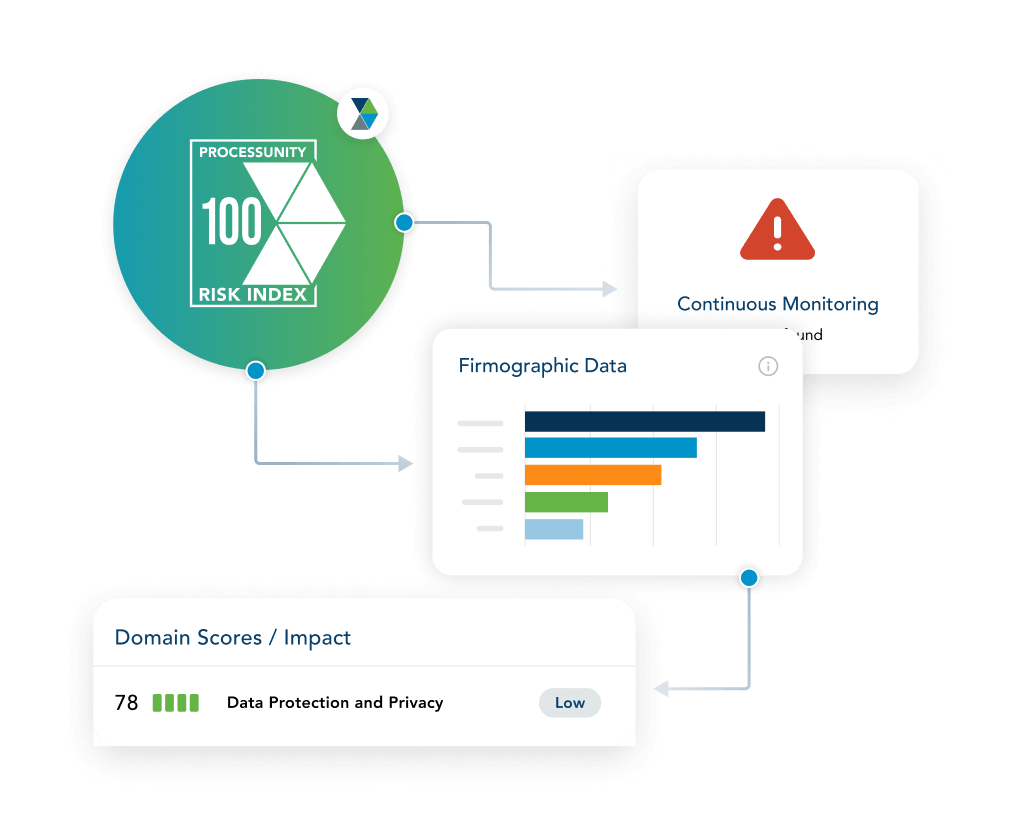
Third-party risk assessments are broken. Your TPRM team needs an easier way to onboard and monitor third parties faster, but you face long cycles – more than 60% wait four months or longer just to receive assessment responses.
ProcessUnity Risk Index flips these challenges on their head with a data-first approach. By embedding the industry’s first controls-driven risk rating into your third-party lifecycle, you make informed, confident decisions with clarity and speed.
What is the ProcessUnity Risk Index?
We’re taking a different approach to rating risk and scoring cybersecurity controls by combining external intelligence with our proprietary controls methodology.
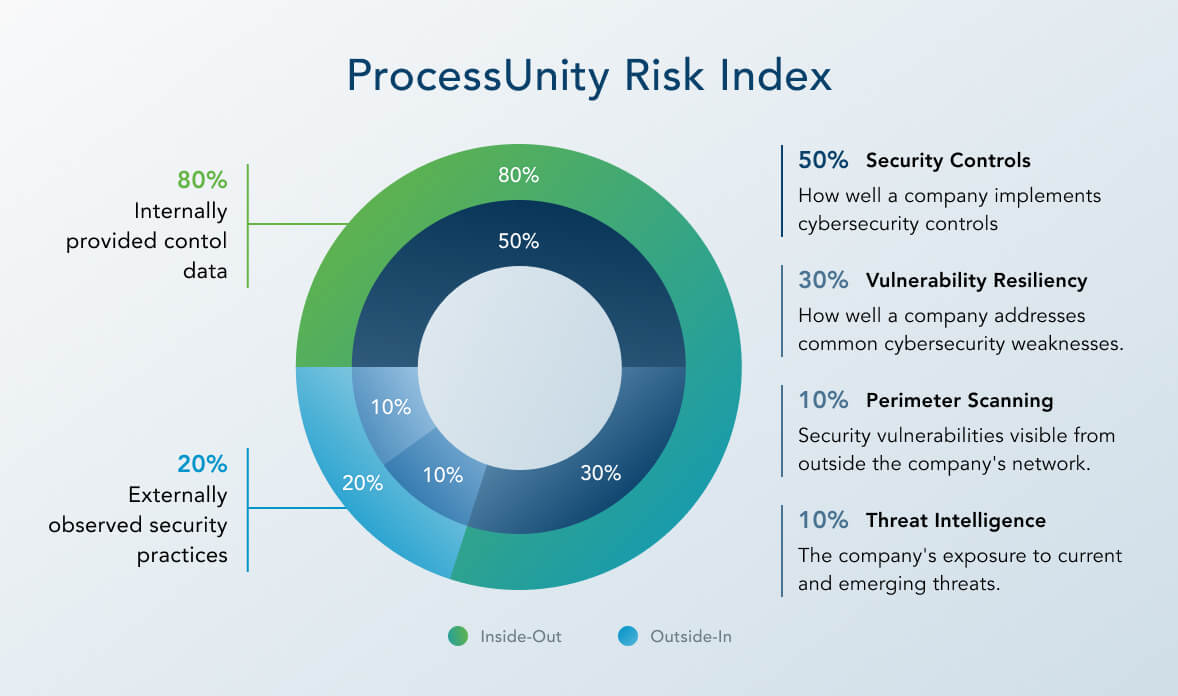
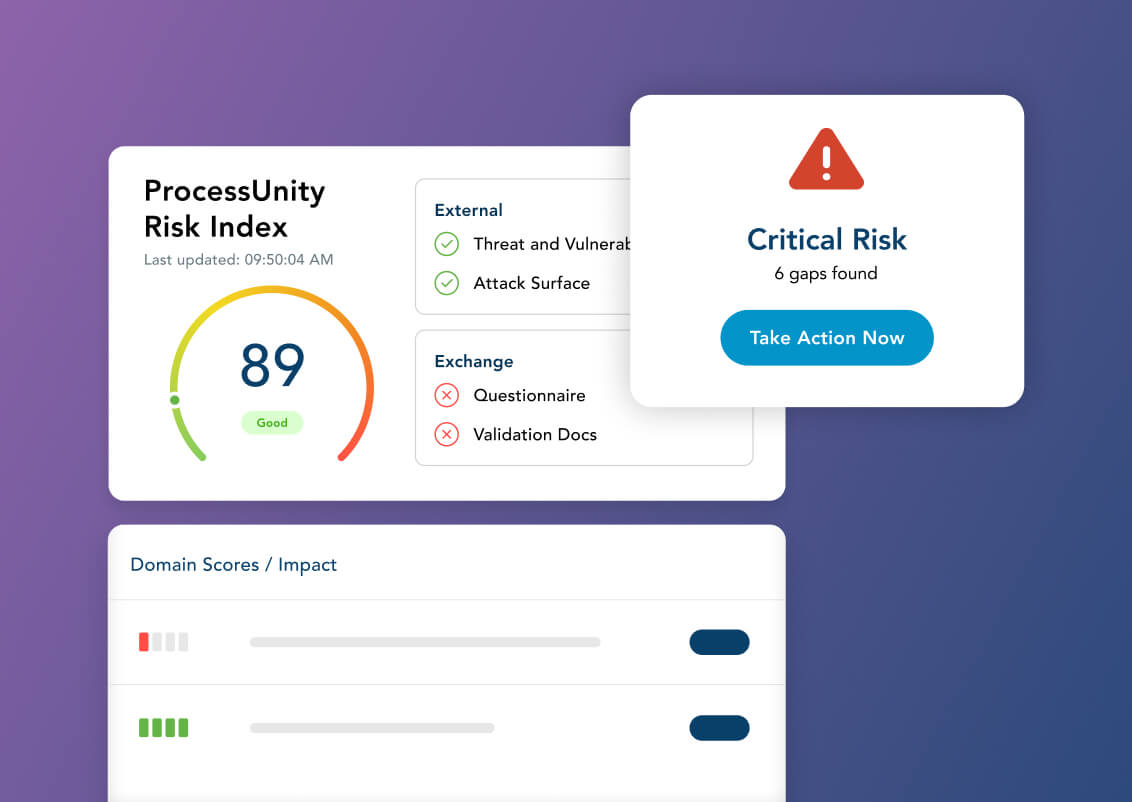
ProcessUnity Risk Index is an actionable 100-point risk rating that unifies internally informed control data with externally observed security signals. The score blends a unique combination of two essential perspectives typically referenced for a complete risk assessment.
With drilldown, domain-level detail, ProcessUnity Risk Index ensures that you have the right level of detail for prioritization and evaluation. The domain-level analysis helps you to proactively evaluate a third party’s security posture without relying solely on an assessment questionnaire. The overall Risk Index score is easily consumable by executives and actionable by analysts within the ProcessUnity workflow platform.
What Goes Into ProcessUnity Risk Index?
The ProcessUnity Risk Index score reflects true vendor risk posture by taking a uniquely holistic approach to risk rating. Rather than summarizing a third party’s risk posture based on externally observed signals or internally informed control data alone, Risk Index combines both data sets into a drill-down view.
Inside-Out (80%): Proprietary intelligence on your third parties
ProcessUnity’s control-based methodology includes proprietary analytics, control data, and expert associations to provide an objective risk benchmark. This baseline provides a layer of objectivity to a third party’s self-attested control data and makes it meaningful in a real-world context. Our control-based methodology includes:
- A firmographic profile
Company name, domain, sector, industry, type, address, size, revenue, age, and description.
- Technographic information
The technologies employed by your third party.
- Control attestations and uploaded evidence directly from your third parties (e.g., SOC 2 reports, ISO certifications, and security policies) provides their updated perspective on their controls.
- Internally informed control data from the third party, or similar companies on the Global Risk Exchange, indicates the probability of their risk controls being effectively implemented, with heavier weighting on controls associated with Common Weakness Enumerations and Mitre ATT&CK techniques.
- Analysis on similar companies to benchmark control implementation and effectiveness.
Built for Every Stage of the TPRM Lifecycle
Onboarding, Prioritization & Tiering
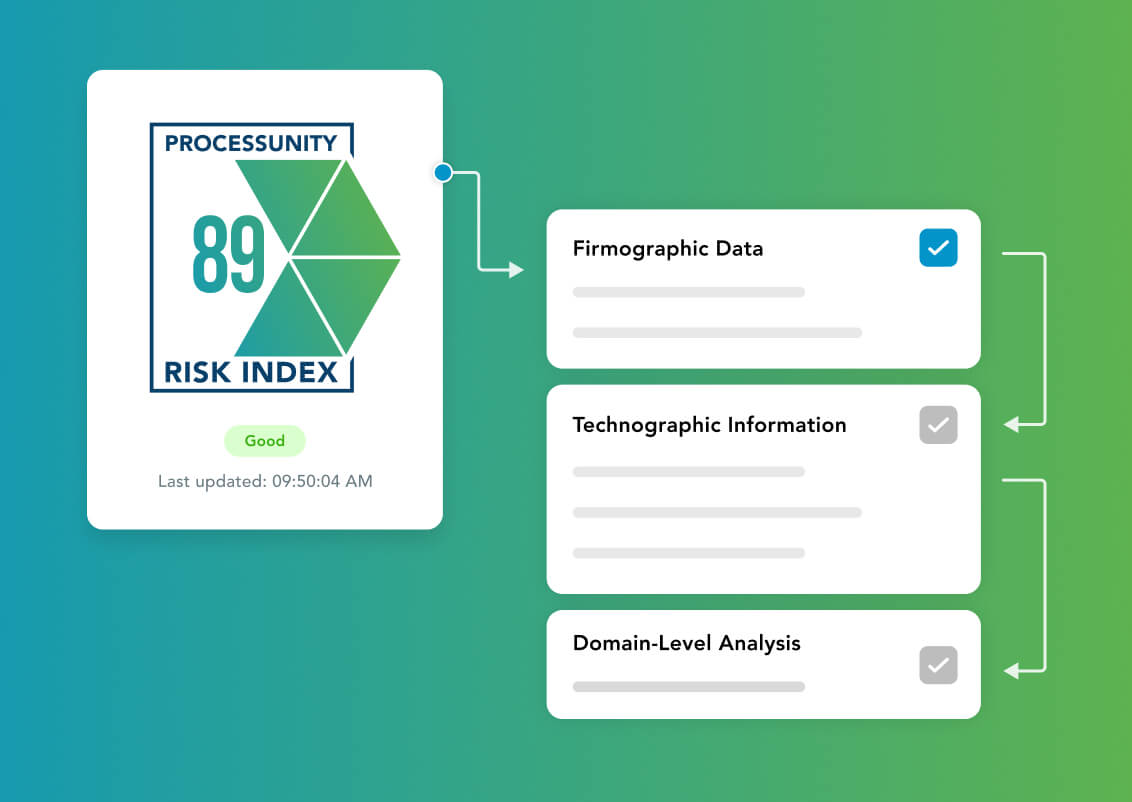
Risk Index allows for instant prioritization of your vendors with a single rating that automates risk tier assignment and scopes due diligence. Vendors are routed into appropriate workflows for pre- and post-contract due diligence based on their risk level, defined by your relationship with the third party. This ensures that high-risk vendors receive deeper scrutiny, while low-risk vendors move quickly through the onboarding process. Vital data points for proper onboarding are centralized for the analyst within a single view, including the ProcessUnity Risk Index score, firmographic data, and domain-level analysis.
Due Diligence & Assessment
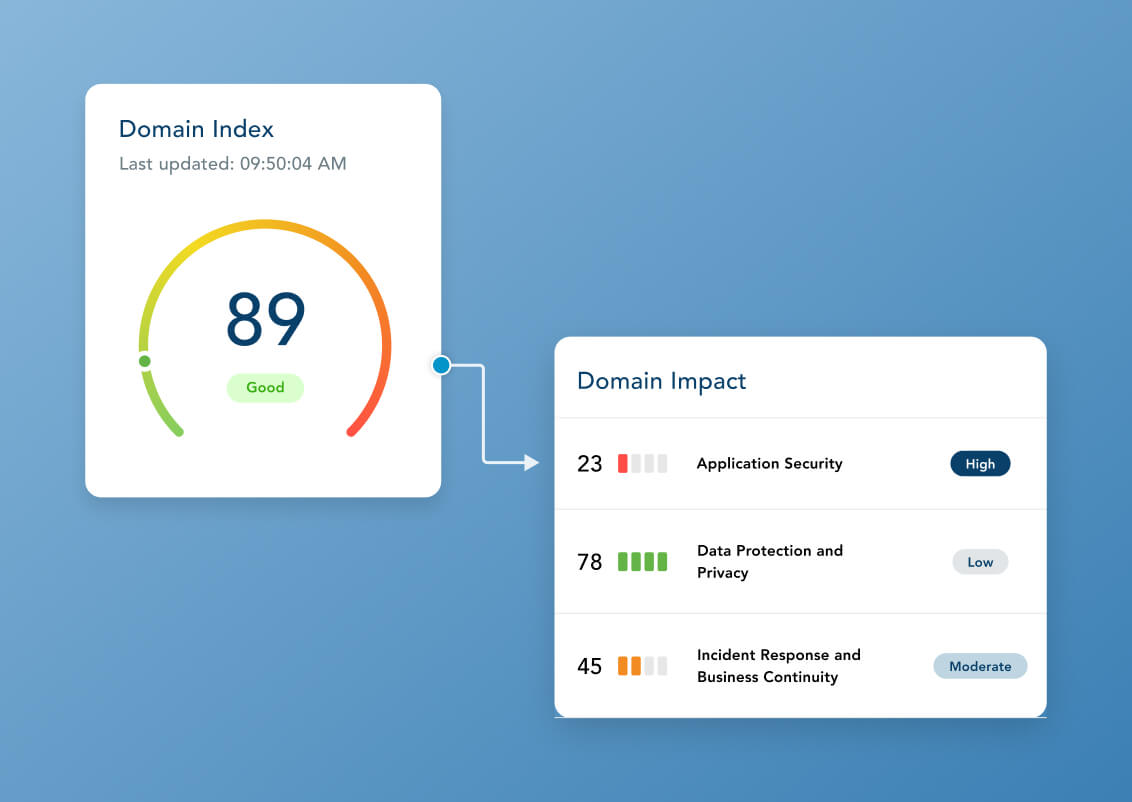
Two key insights at each risk domain guide dynamic scoping during due diligence. Each domain represents a specific area of cybersecurity management, with controls designed to mitigate specific types of risks and threats. Domain Index provides targeted insight into risk while Domain Impact enables you to focus on the most important domains relevant to your business relationship with a third party. With this combined approach, you can target evidence collection around areas of importance, focus on critical controls, and reduce questionnaire fatigue.
Continuous Monitoring
ProcessUnity Risk Index delivers always-on monitoring by combining external threat feeds with internal control updates, filtering alerts down to only those that warrant your attention. When a vendor’s risk posture changes, automated workflows support mitigation plans, ensuring real-time visibility and proactive risk management. You don’t just get the alert. You get structured workflow steps to create an issue and follow it through to remediation.
Why ProcessUnity Risk Index Is Different

A World-Class Controls Methodology
ProcessUnity Risk Index is powered by the most comprehensive and sophisticated cybersecurity controls dataset in the world, combining control attestations from over 18,000 companies, firmographic data, comparative analysis on similar companies to benchmark control implementation and effectiveness, and expert associations to Common Weakness Enumerations (CWEs), MITRE ATT&CK Techniques, and technographic data.

A Unified, Multi-Level View of Vendor Cyber Risk
ProcessUnity Risk Index blends a proprietary control intelligence with externally observed security signals into a single view for quick risk prioritization. Drill down to control-level detail for complete risk domain analysis and control effectiveness review.

Enhanced by Third‑Party Participation
Unlike traditional ratings models, vendors proactively participate in their Risk Index score to ensure a higher degree of accuracy. Vendors provide evidence, validate control performance, and retain full authorization over their documentation and responses. By leading with Risk Index, you reduce reliance on time-intensive questionnaires and improve quality of life for your third parties.
Powered by Workflow Automation
ProcessUnity automates workflow steps at key decision points in the third-party lifecycle, embedding Risk Index details into onboarding, due diligence, and continuous monitoring. This level of automation ensures that Risk Index data isn’t just static information – it’s actionable intelligence.
Get Straight to the Risk Data That Matters
ProcessUnity Risk Index gives you a unified, actionable, and transparent view of third‑party cyber risk.

Resources and Insights

How ProcessUnity Risk Index Powers Action Across the Third-Party Lifecycle
Third-party risk is constantly evolving—yet 64% of large organizations report taking over four months to complete...

ProcessUnity Introduces First Controls-Driven Risk Rating for Third-Party Risk Management
ProcessUnity Risk Index delivers actionable risk scoring, combining inside-out and outside-in intelligence to provide greater clarity...

Webinar Series: The State of Procurement & Third Party Risk: From Market...
The Hackett Group’s 2026 Procurement Agenda reveals a landscape where cybersecurity threats, geopolitical volatility, and AI...

Webinar Series: The State of Third-Party Risk Assessments 2026: Benchmarking the Maturity...
The ProcessUnity State of Third-Party Risk Assessments 2026 uncovered that organizations continue to invest in third-party...

The Cost of the TPRM Maturity Gap
66% of large organizations feel confident in their third-party risk management process. But the results often...

Webinar Series: Accelerate DORA Compliance: Tools and Techniques for Third-Party Risk Management
As a DORA-regulated entity, you face pressure to shape up your supplier risk management program to...
Next Steps:
Schedule a ProcessUnity TPRM Demonstration
Our team is here to show you how forward-thinking organizations are elevating
their Third-Party Risk Management programs and practices to maximize risk
reduction. Start your journey with ProcessUnity today.